
Your RSUs just vested, the shares landed in your Fidelity or Schwab account, and now you are staring at a tax situation that feels way more complicated than it should be. If you work at Amazon, Microsoft, Google, or Meta in Seattle, there is a good chance Washington’s capital gains tax is about to cost you more than you expected — particularly if you have been holding onto shares from earlier vesting periods instead of selling right away.
Here is what trips people up: RSUs get taxed twice. The first hit comes as ordinary income the day they vest. The second comes as capital gains whenever you sell — assuming the stock price moved between vesting and selling. That second tax is where Washington state enters the picture, and the numbers can get painful quickly.
How Washington Capital Gains Tax Hits Your RSUs
Washington charges a 7% tax on long-term capital gains above a $278,000 standard deduction, which gets adjusted each year for inflation. Go above $1 million in long-term gains in a single tax year, and the rate climbs to 9.9% — that is the base 7% plus a 2.9% surtax layered on top.
For anyone holding RSUs, the timing of your sale is everything. When your shares vest, the fair market value on that exact date becomes your cost basis. Sell the shares that same day through a sell-to-cover order and there is no capital gain at all — you got the shares and sold them at the same price. Washington’s capital gains tax does not touch you.
Hold the shares after vesting, though, and you are playing a different game. If the stock price climbs between your vest date and the day you eventually sell, that gap is a capital gain. Keep the shares for more than twelve months past vesting and it becomes a long-term capital gain — which is precisely what Washington taxes. I have seen plenty of engineers in South Lake Union hold shares for two or three years because they believed the stock would keep climbing, only to discover they owe Washington thousands when they finally diversify.
One wrinkle worth knowing: short-term capital gains (shares held less than a year after vesting) dodge the Washington tax entirely. But the federal government still taxes them as ordinary income, which for most Seattle tech workers means a 32% to 37% rate. There is no free path here — just different flavors of tax pain.
The Amazon Year 3 Cliff — A Real Dollar Example
Amazon’s RSU vesting schedule is unlike anything else in big tech: 5% in Year 1, 15% in Year 2, then 40% in Year 3 and 40% in Year 4. The back-loaded structure means your first two years feel almost modest. Then Year 3 hits and a massive chunk of equity shows up on your W-2 all at once.
Let me walk through the math on a realistic scenario. Say you received a $400,000 RSU grant when Amazon stock sat at $150 per share — roughly 2,667 shares total. In Year 1, 5% vests: 133 shares worth about $20,000 at your grant price. You decide to hold them.
Fast forward to Year 3. Amazon stock has climbed to $210. Now 40% of your total grant vests at once — 1,067 shares worth $224,070 at the current price. You paid ordinary income tax on that $224,070 when the shares vested. That part is straightforward.
But remember those 133 shares from Year 1 you held onto? Your cost basis on them was $150, and they are now worth $210 each. Sell them and you have $60 per share in long-term capital gains — $7,980 total. On its own, that is well below the $278,000 deduction. No Washington tax.
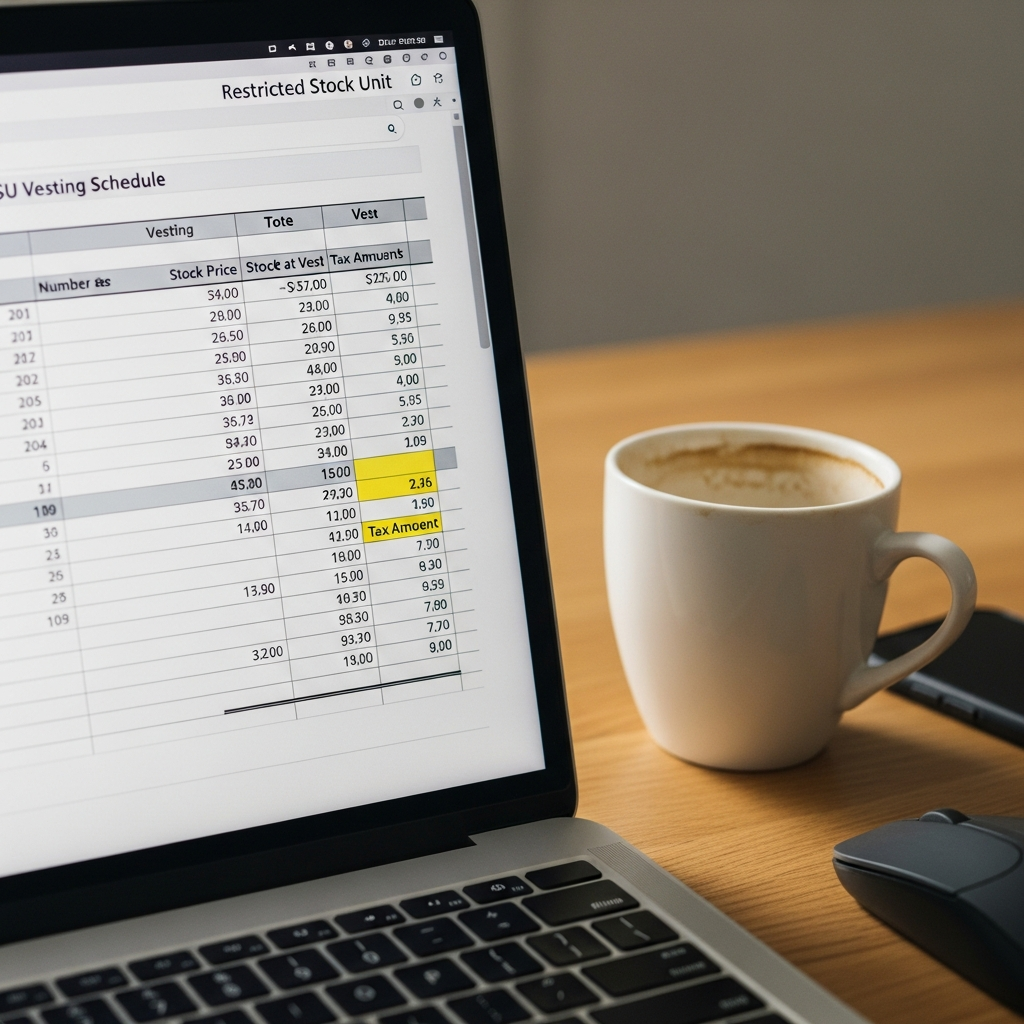
Now layer in the Year 2 shares you also held — 400 shares at a $170 cost basis, now worth $210. Selling those generates another $16,000 in gains. Still manageable by itself. But here is where it compounds: if you also had stock sales from a Microsoft ESPP account, rebalanced some index funds, or exercised any ISOs that same year, all of those gains stack together. A senior engineer carrying multiple years of accumulated RSU shares, a side ESPP account, and some after-tax brokerage holdings can blow past the $278,000 threshold without ever planning to.
Cross that line and Washington takes 7 cents on every dollar above it. At $350,000 in total long-term gains, you owe $5,040 in state capital gains tax. Push past $1 million and the rate jumps to 9.9%. These are real numbers for L7 and Principal-level engineers at Amazon and Microsoft who have been accumulating shares for three or four years in a rising market.
Three Strategies to Reduce Your WA Capital Gains Bill
Strategy 1: Sell at vest, every single time. This is the boring answer and it works. Sell your RSU shares the day they vest, and your cost basis equals the sale price — zero capital gain, zero Washington tax exposure. Most fee-only financial advisors recommend this approach for concentrated stock positions anyway, since it also reduces your single-stock risk. Take the after-tax cash and put it into a diversified portfolio the same week. Not glamorous. Extremely effective.
Strategy 2: Spread your sales across tax years to stay under $278,000. Already sitting on appreciated shares you have been holding? Do not sell everything at once. Add up your long-term gains across every account you own — brokerage, RSUs, ESPP, crypto, all of it — and plan sales so you stay under the $278,000 threshold each calendar year. This takes about 30 minutes in November or December with a spreadsheet. Pull up your year-to-date realized gains, see how much room you have left, and sell accordingly. That half hour of planning can save you $5,000 or more.
Strategy 3: Tax-loss harvest other positions to offset your RSU gains. If you hold a diversified portfolio alongside your company stock, chances are some positions are sitting at a loss right now. Selling those losers creates capital losses that directly offset your gains, shrinking the taxable amount. One important catch for Washington specifically: the state only taxes long-term gains, and it does not tax short-term gains at all. That means short-term losses cannot reduce your WA capital gains bill — only long-term losses count against long-term gains for state purposes. Pick your harvest targets accordingly.
The 2028 Millionaire Tax Changes Everything
Governor Bob Ferguson signed a brand-new 9.9% income tax on March 30, 2026, aimed at individuals earning over $1 million in gross income. It takes effect for tax year 2028. This is not another capital gains tax — it is a broad income tax covering salary, bonuses, RSU vesting income, and essentially everything that shows up on a W-2 or 1099.
For Seattle tech workers who are already managing around the capital gains tax, this stacks on top. Picture a senior Amazon engineer pulling in $350,000 base salary and $700,000 in RSU vesting income — that is $1.05 million in gross income. Starting in 2028, that person owes $4,950 in brand-new state income tax (9.9% on the $50,000 above $1 million). And if they also sell appreciated shares that trigger capital gains above $278,000 in the same year, they are paying both taxes simultaneously.
The smart move is to treat 2026 and 2027 as a planning window. Washington has no income tax right now, and the capital gains tax only kicks in on long-term gains above the deduction. Any Roth IRA conversions, stock option exercises, or large income events you can accelerate into the next 18 months will dodge the millionaire tax completely.
Yes, there is a legal challenge brewing, and tech investor Brian Heywood is pushing a voter referendum that could repeal the whole thing. But the safer move is to plan as if it survives. If it gets struck down, the worst case is you did some smart tax planning slightly ahead of schedule. If it survives and you did nothing, you are handing 9.9% of your income above $1 million to the state when you could have avoided it.
For Seattle RSU holders, the playbook is clear: sell at vest to avoid the capital gains tax, spread large sales across years to stay under $278,000, and seriously think about pulling forward big financial moves before 2028. The tax landscape in Washington is shifting fast, and the planning you do right now has an outsized impact compared to any other year.


Stay in the loop
Get the latest seattle financial advisors updates delivered to your inbox.